Wednesday, March 25, 2020
Assistive Technology
Upon completion of the unit on assistive technologies I can only reflect how thankful I am for DSR. Having a professional, dedicated department that can be called on to help identify and at times create solutions to assist students with varied needs is a wonderful relief. Reflecting on the time I spent in the K-12 setting, I recall making due with the best that we could for all the varied students. This was particularly challenging at a time when there was little assistance for the classroom teacher and computers were also still limited in usefulness and affordability. The vast array of possible tools to level the educational field for those with physical or learning needs is phenomenal. What I wonder about is how can technology now assist the newest hurdle to student learning, mental health struggles? Particularly with the ever growing anxiety issues that more and more students deal with. Certainly that will be the new area of research and development.

Sunday, February 16, 2020
Why do we need to call for assessment reform, and How does it look like? (wk 5)
amazingly contradictory to high stakes standardized tests
Authentic Assessment
Not answer but skills
Uses mistakes made to advance learning and
to performance assessments (correct student)
Authentic connections to IRL
Focus on not to get to the right answer but how to get there
Real-time Assessment
Pre-assessments intro data thru survey (Google)
that then leads to individualization of lesson
Personalized Learning Plan (had id as wanted to investigate from article)
which put students in charge of choices to study
Peer Assessment
(flashback to film strips voice overs)
Student empowering
Ladder of Feedback handouts
makes peer advice clearer
(top should be)
Thank
How has observing and giving feedback
enhanced your own understanding?

Self-assessment
(flashback to film strips voice overs again)
Clear criteria to help focus
Colored pencil technique using rubrics

Single point rubrics
https://www.edutopia.org/article/6-reasons-try-single-point-rubric
Had a rubric as part of 226 but I need to put back in as this!
(note to self ask for input when in Peardeck then use the definition)
Center based off highest column or column 4 of holistic rubric
Student centered + ask students input to create
Single point rubric with scale added

Jennifer Gonzalez offers to share a Google version!!
🧡💛💚💙💜
 https://www.nextgenlearning.org/articles/yes-we-can-define-teach-and-assess-critical-thinking-skills
this site is a great rabbit hole
SAMR model
Week 6: Technology in Assessment Practice"What roles does technology play in our daily assessment practice?"
From the video in the weekly learning unit:
I liked they way he used his phone to record the online interview by the students. In that manner he was able to listen later to their interview while using the class time to work with other students.
I did not copy the video for future reference or use as I had to sign up to view it and I try to limit the number of things I ask my PSTs to sign up for.
https://mybb.gvsu.edu/bbcswebdav/pid-6592215-dt-content-rid-57414838_1/courses/GVEDT626.01.202020/Perspectives%20on%20the%20Integration%20of%20Technology%20and%20Assessment.pdf
sites to try:
Diagnoser and Simscientists
from discussion:
COE
https://www.mursion.com/, and http://www.simschool.org/home/simschool/#howitworks
I liked they way he used his phone to record the online interview by the students. In that manner he was able to listen later to their interview while using the class time to work with other students.
I did not copy the video for future reference or use as I had to sign up to view it and I try to limit the number of things I ask my PSTs to sign up for.
Computer-Based Assessment Methods
https://www.nap.edu/read/11691/chapter/9#171 (the other article link was broken)
Computer-Based Adaptive Assessments
SimulationsComputer-Based and Web-Based GamesElectronic PortfoliosElectronic Questionnaires
Assessments in Education
new idea to me a "do now" assessment
good video for PSTs
High Stakes tests: Distal Level.
Teacher-made test: Proximal Level.
Recitation and Checks for Understanding: Close Level.
Teacher-made test: Proximal Level.
Recitation and Checks for Understanding: Close Level.
More great resources that I need to explore more.
from: Perspectives on the Integration of Technology and Assessment by James W. Pellegrino & Edys S. Quellmalzhttps://mybb.gvsu.edu/bbcswebdav/pid-6592215-dt-content-rid-57414838_1/courses/GVEDT626.01.202020/Perspectives%20on%20the%20Integration%20of%20Technology%20and%20Assessment.pdf
sites to try:
Diagnoser and Simscientists
from discussion:
COE
https://www.mursion.com/, and http://www.simschool.org/home/simschool/#howitworks
http://muve.gse.harvard.edu/rivercityproject/
if not K-12 public :/ then maybe charter
Monday, February 3, 2020
Research and Perspectives on Classroom Assessments
Technology based Assessment allows for responses not available in paper and pen such as hot texts and performance based assessments. I can see this as useful in science particularly in completing labs that are not safe or practical in real life. There are a few simulation sites that I use, such as PhET and WISE.
Black, P., & Wiliam, D. (1998). Inside the black box: Raising standards through classroom assessment. Phi Delta Kappan, 80(2), 139-148
Ideas to implement from Black: stop and jots, turn and talks, and think pair shares.
I plan to use quick notes for questions beforehand or use Padlet or Jamboard
Technology based assessment allows for responses not available in paper and pen such as hot texts and performance based assessments like in Wise.
I would like to investigate Glass labs ed games to see if it fits into my course.
Dr Williams
The video was useful for unpacking formative assessment but wish I could see his slides. I like the way Dr. William's describes the student centered class as lead by the teacher and done with students.
It was suggested to start with asking questions as attention grabbers instead of listing the student learning objectives (SLOs) which "gives the game away". I don't start with SLOs, but end with students identifying their own SLOs. As an inquiry class I spent many years trying to incorporate SLOs in way that didn't spoil the "discovery". Post-tests now have the students list their SLOs that they discuss first in their groups. Then they share the SLOs with the class by writing them in the binder that has the answers for them to check the 2nd part of the post-test, the content based questions.
Dr Darling-Hammond called for HOT skills while encouraging PBL and portfolios.
These videos also demonstrated the convenience of embedding videos. I was able to embed a YouTube video but not the Panopto videos for 226. Additionally, I plan to use FlipGrid to replace a discussion post if I can figure out the teacher side of the site.
edutopia
5 keys: goals and measures/formative/summative/performance/student ownership.
I keep a Padlet: My sweet shelf of ed articles for my students filled with ed articles and plan to add an assessment column.
Week 4
From the discussion post we could apply their model to our ed program and the practicum is a piece of it.
week 4 scattershot articles
Authentic assessment encompasses UDL, PBL, and portfolios. Authentic assessment directs the curriculum. Evidence based assessment should inform our teaching and learning. It follows a constructivist approach. “Knowing is an enactment or process in the
context”.
Evidence based to inform teaching and learning.
CBE hearkens back to trade schools or focused colleges, such as a nursing college, where the curriculum is centered around specific skills and knowledge that are assessed for credentials.
Performance based assessment.
https://www.k12academics.com/education-assessment-evaluation/standards-based-assessment#.WjqJNCOZORs
Standards based that calls for preliminary testing so students are evaluated for how they improve and not compared to a norm. NCLB
Formative even for tests. It is okay to be wrong.
Situative blurs lines between teaching and testing. In the conclusion the article states that teachers need to experience situative assessment before they can effectively use it. The article also identified negative aspects of overly focused formative assessment: learning can be not generalized to wider learning or to narrow to the type of test questions. Test prep is not generalized learning and limited to that actual test.
Dynamic assessment is a test-teach-retest program and needs a normal base line to affectively evaluate
Dynamic assessment is a test-teach-retest program and needs a normal base line to affectively evaluate
Value added compares that years test scores to last years so to
judge teachers. Although, VAMS accounts for outside factors better than single high stakes
test. VAMS are compared between teachers for that year.
Dynamic
assessment is a test-teach-retest program and needs a normal base line.
Most of these readings have me questioning do I really want to fall back into the dismal sea of public k-12 teaching.
Most of these readings have me questioning do I really want to fall back into the dismal sea of public k-12 teaching.
Sunday, January 19, 2020
Assessment in the Classroom Revisited
- Collect only the data needed to the desired outcome.
- Hyper correction affect
- Some summative assessments are necessary.
- Different viewpoints from usual studies and a broader audience
- Key Findings student perceptions pg 10
- Recommendations
New ideas from discussions
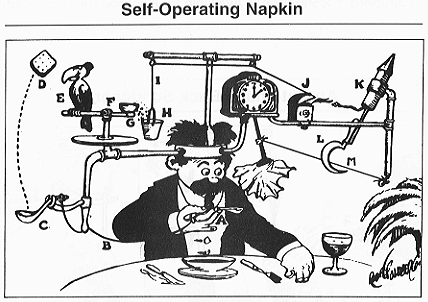
- OK Go video questions: how many times did they have to run that Rube Goldberg machine?!
- Not letting a bad day/quiz/homework define us
- Rube Goldberg machines for energy performance assessment
- Making learning a collaborative venture with the student and the teacher and removing the "us versus them" mindset
Saturday, January 11, 2020
Reflective Blog Journal Enter the Hall-way
Since as I understand it, a blog is an informal, online, multimedia capable journal. To that end, I intend to use this as a way to keep track of key ideas. My focus then is two pronged and arranged in that manner. Either collecting useful information I would share with my course now, Sci 226 pre-service K-5 teachers, or hoarding what might be handy if I move into a middle school science classroom next year.
Sci 226
Middle school
Both
Personal
Sci 226
Middle school
Both
Personal
Subscribe to:
Posts (Atom)
-
Why do we need to call for assessment reform, and How does it look like? (wk 5) https://tech.ed.gov/netp/assessment/ amazingl...
-
Research and Perspectives on Classroom Assessments *from course: Weekly Learning Modules Technology based Assessment allows for...
-
The most interesting pieces I found in this section were in the exploration activity. Dr. William's video ( https://www.youtube.com...


